
When Jurisdiction Cannot Be Waived: Federal Court Filing Challenges Breakdown in Military Commission Appellate Review
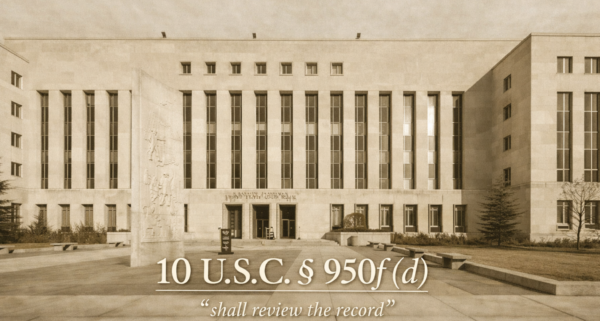
A newly filed Reply to Show Cause in the U.S. Court of Appeals for the District of Columbia Circuit presses a question that goes to the core of constitutional structure and the rule of law: What happens when a court charged by Congress with mandatory review refuses to exercise it?
Filed by Annie W. Morgan, Senior Military Criminal Defense Attorney with Law Offices of David P. Sheldon, PLLC, the reply urges the Court to reject dismissal and allow review to proceed—not to relitigate the merits of a conviction, but to determine whether the Court of Military Commission Review (CMCR) lawfully declined to perform a review Congress expressly required.
At issue is a sharp but fundamental distinction. While a prior appellate decision enforced a forum-specific waiver of merits review in the D.C. Circuit, the current petition raises a different and antecedent question: whether jurisdictional obligations imposed by statute can be nullified by waiver at all.
The filing argues they cannot.
Congress, through the Military Commissions Act, directed that once a case is referred to the CMCR, that court shall review the entire record. The Reply explains that this mandate is not discretionary, not contingent, and not erased by an accused person’s waiver of review in a separate forum. Jurisdiction, the filing emphasizes, is structural. It belongs to Congress, not to litigants, not to prosecutors, and not to courts seeking to avoid review.
“This is not an effort to reopen a conviction,” the Reply makes clear. “It is an effort to ensure that the tribunal Congress created actually performed the review Congress required.”
The filing situates the issue within longstanding Supreme Court doctrine holding that subject-matter jurisdiction cannot be created or destroyed by waiver, agreement, or silence. It also warns that dismissing the petition would effectively read an entire statutory provision out of the law, collapsing a two-tier appellate system into a single, optional layer and undermining congressional design.
More broadly, the Reply frames the dispute as one of institutional accountability. When a court charged with mandatory review declines to act, and when no court is willing to ask whether that refusal was lawful, the structure meant to safeguard rights ceases to function. The filing argues that this is precisely the kind of “on-the-ground failure” that federal courts are obligated to address.
The Court is now asked to decide whether it will examine that failure—or allow a jurisdictional vacuum to stand.
Why This Filing Matters
- Jurisdiction is not optional. Courts cannot waive away duties Congress imposed.
- Mandatory review safeguards legitimacy. Plenary appellate review is not a technicality; it is a structural protection.
- Waiver has limits. A waiver of merits review in one court does not nullify statutory obligations in another.
- Rule-of-law implications extend beyond one case. The outcome affects how military commission review functions system-wide.
About the Firm
Law Offices of David P. Sheldon, PLLC is a Washington, D.C.–based law firm representing military service members, federal employees, and civilians worldwide. The firm is nationally recognized for its work in courts-martial, military commission litigation, federal appellate advocacy, constitutional challenges, and complex jurisdictional disputes.
Disclaimer
This press release is for informational purposes only and does not constitute legal advice. The content reflects allegations and legal arguments contained in a public court filing. No client identifying information is included.