
They Served Anyway: Black Americans, Military Service, and the Measure of a Nation
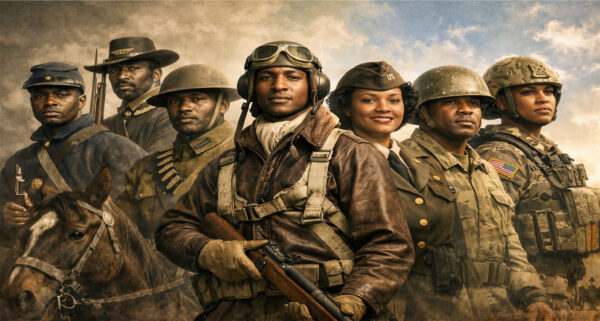
There is a through-line in American history that does not bend with convenience or recognition. It is written not in speeches or proclamations, but in uniforms worn under unequal laws, in hands that steadied rifles and medical instruments alike, in discipline upheld even when dignity was denied.
Black Americans have served this nation in every war it has fought. They served when freedom was still theoretical. They served when segregation was official policy. They served when the nation asked for loyalty but offered exclusion in return. And they continue to serve today, across every branch of the Armed Forces, in combat and non-combat roles, armed and unarmed, visible and unseen.
This is not a side story of American military history. It is one of its central truths.
Long before full citizenship was recognized, Black Americans were already defending the idea of America itself. During the Civil War, the formation of the United States Colored Troops marked a turning point not only in the war’s outcome, but in the nation’s moral trajectory. More than 180,000 Black men enlisted in the Union Army, with thousands more serving in the Navy. They fought for a country that still questioned their humanity, knowing that defeat meant the permanence of bondage, not only for themselves, but for generations to come.
After the war, service did not yield equality. Instead, it produced new battlegrounds. Black soldiers were organized into segregated regiments, later known as the Buffalo Soldiers, and sent westward to patrol frontiers, build infrastructure, protect settlements, and fight in conflicts few Americans today remember. Their professionalism was unquestioned by those who served beside them, yet they were routinely barred from advancement and leadership. Even so, they stayed.
When the United States entered World War I, Black Americans again stepped forward. The 369th Infantry Regiment, famously known as the Harlem Hellfighters, spent more time in front-line trenches than any other American unit of comparable size. They fought under French command because their own military would not fully integrate them. They returned home as heroes abroad,and second-class citizens at home.
World War II magnified the contradiction. America fought fascism overseas while maintaining segregation within its own ranks. Yet Black service members met that contradiction not with withdrawal, but with excellence.
In the skies over Europe, the Tuskegee Airmen dismantled myths that had been used for decades to justify exclusion. Their success was measured not in propaganda, but in discipline, skill, and mission completion. On the ground, the 761st Tank Battalion pushed through some of the war’s fiercest fighting, earning respect the system had long withheld.
Black Marines trained at Montford Point, under conditions designed to discourage them. Instead, they laid the foundation for the fully integrated Marine Corps that exists today.
And amid this history, Black women served with distinction, often without recognition. The 6888th Central Postal Directory Battalion, the only all-Black, all-female unit deployed overseas during World War II, was tasked with clearing years of backlogged mail. Their work restored morale across entire theaters of war. They did it under segregation, sexism, and wartime pressure and completed the mission ahead of schedule.
Acts of individual heroism also forced institutional reckoning. When Doris Miller, serving as a mess attendant aboard the USS West Virginia, took up a weapon during the attack on Pearl Harbor and helped save wounded sailors, the Navy could no longer justify excluding Black service members from combat roles while demanding combat courage.
Change, when it came, it came late. Harry S. Truman signed Executive Order 9981 in 1948, formally desegregating the Armed Forces. But that order did not create equality, it acknowledged what Black service members had already proven for generations.
Today, Black men and women serve across every military branch, in command positions, in legal and medical corps, in logistics, intelligence, cyber operations, and frontline combat roles. Their service strengthens readiness. Their leadership shapes doctrine. Their presence makes the institution more honest.
Black History Month is not about asking whether Black Americans belong in the military. History has already answered that question. It is about recognizing that the Armed Forces have been shaped fundamentally and permanently by those who served anyway.
Disclaimer:
This content is intended for educational and informational purposes and reflects historical records from government and museum sources. It does not constitute legal advice.