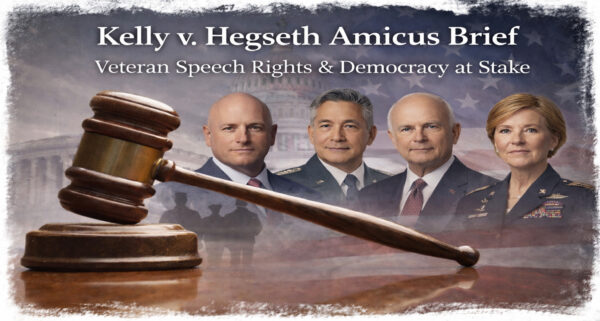
A powerful amicus curiae brief filed in Kelly v. Hegseth brings together an extraordinary coalition of former service secretaries, retired senior military leaders, and veteran advocates to deliver a unified warning to the court: punishing a retired service member for truthful public speech about military law threatens democratic self-government and chills the voices of millions of veterans nationwide.
This is not an abstract dispute about decorum or discipline. It is a case about who gets to speak, what the law actually requires, and whether veterans remain full participants in civic life after they hang up the uniform.
The Case at the Center
The lawsuit was brought by Mark Kelly, a retired U.S. Navy Captain and sitting U.S. Senator, after the Department of Defense took the unprecedented step of formally censuring him for public statements explaining a settled principle of military law: service members have a duty to disobey unlawful orders.
The defendant is Pete Hegseth, sued in his official capacity.
The amicus brief supports Senator Kelly’s request for a preliminary injunction, warning that allowing this punishment to stand would dramatically expand executive power over veteran speech.
Who Filed the Amicus Brief—and Why Their Voices Matter
Former Service Secretaries: Civilian Oversight at Stake
Among the amici are former civilian leaders entrusted with oversight of the armed forces, including:
- Louis E. Caldera
- Sean C. O’Keefe
Their participation signals that this case is not about politics—it is about preserving lawful civilian-military norms and constitutional boundaries.
Retired Generals and Admirals: Unmatched Military Authority
More than 40 retired senior officers across every branch of the armed forces signed the brief. Collectively, they served under every president from Dwight D. Eisenhower to Donald J. Trump.
Notable signatories include:
- Antonio Taguba, known for leading the Abu Ghraib investigation
- Michael V. Hayden, former Director of the CIA and NSA
- Claudia J. Kennedy, the first woman to reach three-star rank in the Army
- Thad W. Allen, former Commandant of the Coast Guard
These are not marginal critics. They are the leaders who trained troops, commanded forces, enforced military law, and safeguarded the institution’s credibility.
Veteran Civil Society: The Broader Impact
The brief is also joined by Vet Voice Foundation, a non-partisan organization representing nearly two million veterans and military family members.
Their involvement highlights the real-world consequences: when veteran speech is chilled, public debate suffers—and so does democratic accountability.
Counsel for the Amici
The amici are represented by leading democracy and constitutional-law organizations:
- Protect Democracy Project
- States United Democracy Center
What the Amicus Brief Argues—At a Glance
- Veteran Participation Is Essential to Democracy
Veterans serve throughout public life—as legislators, judges, journalists, educators, and advocates. Silencing them deprives the public of informed perspectives on national security and military policy.
- The Duty to Disobey Unlawful Orders Is Settled Law
The brief traces this principle through U.S. military case law, the Law of War, the Uniform Code of Military Justice, and post-World War II precedent. Explaining this duty publicly is accurate, lawful, and necessary, not misconduct.
- UCMJ Speech Limits Do Not Apply to This Case
Even for active-duty service members, speech may be restricted only where there is a direct and palpable connection to military mission or discipline. That standard is nowhere close to being met here—especially for a retired officer holding elected office.
If the government’s position were accepted, the brief warns, no meaningful First Amendment protection would remain for veterans.
Why This Moment Matters
The amici make clear that they filed this brief despite recognizing the risk of retaliation themselves. That chilling effect is the constitutional injury at the heart of this case.
If a retired service member can be punished for accurately explaining military law—then every veteran’s voice becomes conditional, subject to political approval.
This case is about more than one Senator. It is about whether service ends with silence—or whether veterans remain full participants in the democracy they defended.
Documents
Kelly amicus brief
1 Complaint Kelly v. Hegseth, 1.12.26
2 Kelly motion for emergency TRO and PI, 1.12.26
Amicus brief in support of Kelly, 1.20.26
4 Govt opposition to Kelly PI motion, 1.22.26
Senator Kelly Reply brief in support of PI motion, 1.26.26
Citations & References
- Brief of Amici Curiae Former Service Secretaries, Retired Senior Military Officers, and Vet Voice Foundation in Support of Plaintiff’s Motion for Preliminary Injunction and Stay, Kelly v. Hegseth, No. 1:26-cv-00081-RJL (D.D.C. Jan. 20, 2026). Kelly amicus brief
- Uniform Code of Military Justice; Manual for Courts-Martial
- United States v. Calley, 48 C.M.R. 19 (1973)
- United States v. Huet-Vaughn, 43 M.J. 105 (C.A.A.F. 1995)
- Department of Defense Law of War Manual