
Know Your Status, Know Your Orders: What Service Members Must Understand Before Domestic Deployment

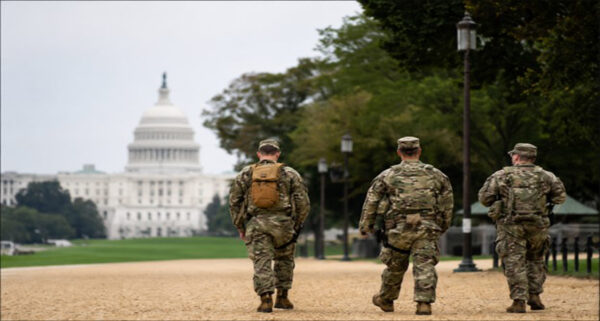
National Guard can be seen walking around the Capital in DC

When the Mission Changes, So Do the Rules

A service member gets the call.

But this time, it is not for overseas deployment, combat operations, or traditional military training. Instead, the mission sounds different: support public safety, assist local authorities, protect infrastructure, respond to civil unrest, help during natural disasters, or provide emergency assistance at home.

Questions begin to surface quickly.

Can they legally deploy me for this?
Are we acting as military personnel, or law enforcement?
Do I have authority to stop or detain civilians?
Can I be assigned work outside my specialty?
What happens if something feels legally wrong?

These are not political questions.

They are professional ones.

As hurricanes, border missions, wildfire response, public health emergencies, and civil disturbance operations have increased, military members, especially Reservists, National Guard personnel are increasingly being asked to support missions that feel very different from what they expected when they joined.

For service members, one simple rule matters more than ever:

Know your status. Know your mission. Know your authority. And document concerns early.

Those four principles can help protect careers, preserve legal rights, and prevent service members from finding themselves caught in legal uncertainty after a mission ends.

The Same Uniform Does Not Always Mean the Same Authority

One of the biggest misunderstandings surrounding domestic military missions is this:

The legal authority behind a mission depends on your status, not simply the uniform you are wearing.

Two service members standing side by side in uniform may have very different legal authorities depending on who activated them and under what law.

Understanding your legal status matters.

State Active Duty: Governor-Controlled Missions

When National Guard members are activated by a governor under state law, they are generally operating in State Active-Duty status.

These missions often include:

  • wildfire response
  • flood and hurricane recovery
  • evacuation assistance
  • emergency medical support
  • search and rescue
  • public safety operations during emergencies

In many states, National Guard members under state authority may lawfully assist with public safety functions and, depending on state law, may even support law enforcement activities.

The Governor, not the President, typically controls the mission.

Title 32: State Command, Federal Funding

Under Title 32 of the United States Code, National Guard members remain under state control while receiving federal funding.

Title 32 missions commonly include:

  • airport security
  • border operations
  • public health response
  • disaster relief
  • infrastructure support

During the COVID-19 pandemic, many Guard members operated under Title 32 authority to support testing, vaccinations, logistics, transportation, and overwhelmed healthcare systems.

Although federally funded, service members in Title 32 status generally remain under the governor’s command. 10 U.S.C. Title 32 Overview

Title 10: Federal Military Authority

When Guard members are federalized, or when active-duty military personnel are used domestically, they generally operate under Title 10 authority.

This matters because of a law called the Posse Comitatus Act, which limits the military’s role in domestic civilian law enforcement.

In general, federal troops are not police officers.

That means military personnel ordinarily cannot:

  • conduct civilian arrests
  • investigate civilian crimes
  • search homes without lawful authority
  • engage in ordinary civilian policing

Federal forces may still lawfully provide:

  • security for federal property
  • transportation support
  • engineering assistance
  • medical aid
  • logistics and supply distribution
  • communications support
  • emergency response coordination

The legal difference is important:

Supporting civilian authorities is often lawful. Replacing civilian law enforcement is a very different legal question.

The Posse Comitatus Act, enacted after Reconstruction, remains one of the most important legal boundaries governing domestic military use. 18 U.S.C. § 1385 – Posse Comitatus Act

“That’s Not My MOS” Usually Is Not the Legal Issue

Many service members understandably wonder:

“This isn’t what I signed up for.”

The reality is that military members are routinely assigned work outside their normal specialties.

An intelligence officer may support logistics.

An infantry member may assist with wildfire response.

A mechanic may help distribute supplies during an emergency.

Medical personnel may work outside normal treatment settings.

The military often requires flexibility.

The better legal question is not:

“Is this part of my MOS?”

The better question is:

“Is this mission lawful, authorized, and within the legal limits of my authority?”

Military necessity can expand duties.

It does not eliminate legal boundaries.

Service Members Still Have a Duty to Recognize Unlawful Orders

The military expects obedience to lawful orders.

But military service has always included another duty:

The obligation to recognize and refuse manifestly unlawful orders.

This is not politics.

This is professionalism.

The Uniform Code of Military Justice (UCMJ) requires obedience to lawful orders, but military law has long recognized that service members cannot shield themselves behind obviously unlawful conduct. Courts and military justice systems have repeatedly reinforced that unlawful acts cannot be justified simply because “I was following orders.” Manual for Courts-Martial (2024 Edition)

Most domestic missions are lawful and necessary.

Military personnel routinely save lives during disasters, stabilize communities, and provide critical support during emergencies.

But questions arise when military support begins to resemble ordinary policing, or when service members are unclear about their legal authority.

Service members should professionally seek clarification if they are ordered to:

  • detain civilians without clear authority
  • conduct searches lacking legal authorization
  • use force outside established rules
  • perform actions exceeding mission guidance

That does not mean refusing lawful orders because something feels uncomfortable.

It means understanding the mission before acting.

Know When the Law Changes: The Insurrection Act Exception

One important exception exists.

The Insurrection Act allows the President to use military personnel domestically under specific circumstances, including rebellion, insurrection, or situations where federal law cannot otherwise be enforced.

When lawfully invoked, military personnel may be authorized to perform functions that would ordinarily be restricted under the Posse Comitatus Act. However, the legal threshold is high, and historically such use has been rare. 10 U.S.C. §§ 251–255 – Insurrection Act Authorities

For service members, the lesson is simple:

Know what legal authority governs your mission.

The rules can change quickly.

Document Concerns Early and Not After an Investigation Starts

This may be the most important lesson of all.

Too often, service members wait until an incident becomes an investigation before trying to reconstruct what happened.

By then:

  • emails are gone
  • memories fade
  • orders become harder to verify
  • witnesses transfer or separate

If something appears legally unclear, service members should document concerns early.

That does not mean becoming confrontational or refusing lawful orders.

It means acting professionally and protecting yourself.

Practical steps may include:

  • asking for clarification regarding mission authority
  • requesting written guidance when available
  • understanding rules of engagement or use-of-force policies
  • maintaining copies of orders when permitted
  • documenting dates, instructions, and chain-of-command guidance
  • preserving relevant written communications

A simple truth applies:

The worst time to question legal authority is after someone has already become the subject of an investigation.

Documentation is not insubordination.

Documentation protects service members when missions later become subject to legal review.

Why This Matters Now

Domestic military missions are no longer rare.

Recent litigation involving the deployment of National Guard personnel in Washington, D.C., has renewed legal debate about how, when, and under what authority Guard members may be used in public safety roles. Courts continue to examine the boundaries between lawful military support and impermissible domestic law enforcement functions.

These legal questions matter because service members can later face scrutiny for actions taken during legally complex missions.

When courts, agencies, governors, and federal officials disagree about authority, military members should understand the legal framework behind their mission and document concerns early if uncertainty exists.

Final Thought: Know the Mission Before the Mission Knows You

Most service members answer the call without hesitation.

They show up during disasters. They protect communities. They assist Americans in moments of crisis.

Domestic missions are often lawful, necessary, and honorable.

But service members should never assume that because they were handed a mission, every legal question has already been resolved for them.

When military and civilian roles overlap, clarity matters.

Before stepping into any domestic deployment, remember four simple rules:

Know your status. Know your mission. Know your authority. And document concerns early.

Doing so may protect not only your career—but also your integrity and the public trust placed in America’s armed forces.

Additional Reading:

Primary Legal Authorities

Current Legal Commentary & Reporting


Disclaimer:

This article is for informational purposes only and does not constitute legal advice. Reading this article does not create an attorney-client relationship with the Law Offices of David P. Sheldon, PLLC. Service members facing questions regarding deployment authority, lawful orders, investigations, adverse actions, or military administrative concerns should seek qualified legal counsel.

About the Law Offices of David P. Sheldon, PLLC

The Law Offices of David P. Sheldon, PLLC represents military service members, veterans, federal employees, and uniformed personnel worldwide in military justice, courts-martial defense, military discharge upgrades, correction of military records, medical retirement (MEB/PEB), federal employment law, security clearance matters, and appellate litigation. Based in Washington, D.C., the firm advocates for active-duty service members, National Guard personnel, Reservists, and veterans navigating complex legal challenges affecting their careers, benefits, and futures.

Learn more at: militarydefense.com

Seeking Fairness After Service: AFBCMR Petition Challenges Unjust Record and Sentence Consequences

Federal Lawsuit Filed

A former United States Air Force officer has petitioned the Air Force Board for the Correction of Military Records (AFBCMR) to correct military records that continue to carry the weight of a flawed disciplinary outcome long after service to the nation ended.

The application asks the Board to confront a core question of military justice: what happens when punishment outlives fairness.

The petition details how administrative and sentencing actions-imposed years earlier produced lasting professional and personal harm that no longer reflect the service member’s actual conduct, rehabilitation, or record of post-service responsibility. The request seeks correction of records to remove or mitigate consequences that remain disproportionate to the underlying offense and inconsistent with constitutional due process, evolving military justice standards, and equity principles applied in similar cases.

This case is not about relitigating guilt. It is about whether the military’s permanent records should continue to impose penalties that the justice system itself has already recognized as excessive, procedurally flawed, or no longer warranted.

When a Sentence Never Ends

According to the filing, the service member completed all imposed punishment years ago. Yet collateral consequences embedded in official Air Force records have continued to follow them into civilian life, affecting employment prospects, reputation, and future opportunities for service and contribution.

The petition explains that sentencing errors and post-trial irregularities compounded the harm, including reliance on disciplinary outcomes that were later questioned or modified but never fully corrected in the official record. The result is a permanent administrative shadow that extends far beyond the intended scope of punishment.

At its core, the request urges the AFBCMR to exercise its statutory authority to correct injustice where rigid adherence to past records no longer serves fairness, discipline, or the integrity of the military justice system.

Why This Case Matters Beyond One Record

AFBCMR cases rarely make headlines, but they shape how the military balances accountability with rehabilitation. The petition underscores a broader concern shared by many former service members: that even after completing punishment, administrative records can continue to function as a second, unofficial sentence.

The filing emphasizes that military justice is not meant to be purely punitive. It is intended to be corrective, proportional, and consistent with constitutional protections. When records fail to reflect that balance, the AFBCMR exists as the final safeguard.

The petition focuses squarely on the service member’s experience, the lasting impact of the record, and the need for equitable correction under governing law.

What Happens Next

The AFBCMR will review the application, supporting memorandum, and exhibits submitted with the petition. If the Board grants relief, the correction could restore accuracy to the official record and eliminate ongoing consequences that no longer serve justice or military discipline.

For many former service members, AFBCMR decisions represent the final opportunity for institutional acknowledgment that fairness must sometimes prevail over permanence.

About the Law Offices of David P. Sheldon, PLLC

The Law Offices of David P. Sheldon, PLLC is a Washington, DC–based military and federal employment law firm representing service members, veterans, and federal employees worldwide in courts-martial, administrative boards, record correction cases, security clearance matters, and constitutional challenges.

Disclaimer

This press release is provided for informational purposes only and does not constitute legal advice. Past outcomes do not guarantee future results. The client’s identity has been withheld to protect privacy.


When Service Is Met With Silence: Army Officer Secures Six-Figure Military Medical Malpractice Settlement

employment law unfair workplace transition

She volunteered to serve. She trained to lead. And when she was injured, she trusted the military medical system to do what it promised.

Instead, a delayed diagnosis and treatment of a serious hip injury at a military treatment facility left her in escalating pain, struggling with mobility, and ultimately forced into medical retirement, ending a military career she had worked years to build.

After challenging the Army’s initial determination and pursuing accountability under the Military Claims Act, the officer has secured a six-figure settlement resolving her medical malpractice claim.

She was represented by the Law Offices of David P. Sheldon, PLLC.

A Delay That Changed Everything

In early 2022, the officer presented to a military hospital with symptoms that should have prompted urgent evaluation of a hip injury. According to the Army’s own findings, the injury was not timely diagnosed, delaying appropriate surgical care and prolonging her pain and suffering.

During the delay, she was instructed to continue physical movement and therapy, guidance that exacerbated her pain and limited her ability to perform basic daily activities.

What began as a treatable hip injury became something far more devastating.

She ultimately required surgical intervention. Despite treatment, the consequences lingered, chronic pain, lasting mobility limitations, and the loss of a military future.

Challenging the Initial Determination

The Army initially offered a substantially lower settlement amount. Through a formal request for reconsideration, supported by affidavits, medical records, and a detailed accounting of her physical, emotional, and professional losses, her legal team challenged that determination.

The Army ultimately agreed to a six-figure resolution, formalized through a Stipulation for Compromise Settlement and Release under 10 U.S.C. § 2733.

“This case was never just about a medical mistake,” said the Law Offices of David P. Sheldon, PLLC.

“It was about what happens when a service member’s pain is dismissed, their injury is delayed in treatment, and the consequences alter the course of their life. The Military Claims Act exists so service members have a pathway to accountability when preventable medical errors occur. She stood up and she was heard.”

Why This Case Matters

For decades, active-duty service members had no meaningful remedy for medical malpractice. That changed with the passage of the 2020 National Defense Authorization Act, which expanded the Military Claims Act to allow claims arising from negligent medical care.

This case demonstrates that process working but only after persistence.

It underscores critical truths:

  • Delays in diagnosing hip injuries can permanently alter outcomes
  • Pain and suffering prior to surgery matter
  • Initial determinations can be challenged
  • Service members retain rights, even while serving

A Victory Beyond the Settlement

No settlement restores lost time or a career ended too soon.

But justice is not measured only in dollars.

It is measured in acknowledgment.
In accountability.
In refusing to accept silence.

This officer pursued her claim not only for herself, but to affirm a principle too often overlooked — service does not require surrendering the right to competent medical care.

About the Law Offices of David P. Sheldon, PLLC

The Law Offices of David P. Sheldon, PLLC, based in Washington, DC, represents military service members, veterans, and federal employees worldwide. The firm focuses on military justice, medical retirement and disability cases, correction of military records, and Military Claims Act litigation, advocating for those whose service deserves protection under the law.

Disclaimer

This press release is for informational purposes only and does not constitute legal advice. Each case is fact-specific, and outcomes depend on individual circumstances. The settlement described does not constitute an admission of liability by the United States. Past results do not guarantee future outcomes.

Why Retired JAGs Are Warning Against Mission Creep

Across generations of American law, one principle has remained remarkably consistent: the military does not enforce civilian law.

It is a boundary rooted in the Constitution, reinforced by statute, and preserved by professional norms within the armed forces. When retired Judge Advocates raise concerns that military lawyers are being reassigned to prosecute non-military offenses, they are not simply debating bureaucratic policy. They are warning about the erosion of a structural safeguard in American democracy.

Their concerns deserve careful attention.

The Traditional Role of the JAG Corps

Judge Advocates occupy a unique position in the American legal system. They serve simultaneously as commissioned officers and attorneys bound by professional ethical obligations. Their responsibilities historically center on advising commanders on military operations and the law of armed conflict, prosecuting and defending cases under the Uniform Code of Military Justice, and protecting the legal rights of service members.

The JAG Corps exists to serve the military justice system. Its core purpose is to support commanders and ensure the fair administration of justice for those serving in uniform.

The Uniform Code of Military Justice reflects that limited jurisdiction. In most circumstances it governs service members, reservists on active duty, and in rare circumstances civilians accompanying forces during wartime. It does not serve as a vehicle for prosecuting ordinary civilian crimes.

Expanding the role of military lawyers beyond that framework raises fundamental legal and constitutional questions.

The Legal Boundary Between Military and Civilian Law Enforcement

At the center of this debate lies one of the most important but frequently misunderstood statutes in American law: the Posse Comitatus Act.

Passed in 1878, the law restricts the use of federal military forces in civilian law enforcement unless expressly authorized by Congress or the Constitution. The statute reflects a deep historical concern about the dangers of military power being used to enforce domestic law.

The United States has traditionally maintained a clear division between military authority and civilian policing. While the military may provide logistical support or technical assistance to civilian agencies in certain circumstances, direct law enforcement functions have historically remained outside its mission.

This separation protects both institutions. Civilian law enforcement remains accountable to civilian courts and communities, while the military remains focused on national defense.

When military lawyers are reassigned to prosecute civilian cases, the line between these two systems begins to blur.

A Legal Gray Area

The legal picture becomes more complicated when military attorneys are temporarily detailed to civilian agencies.

For decades, some Judge Advocates have served as Special Assistant U.S. Attorneys for cases involving crimes committed on military installations or involving service members. Congress eventually authorized such arrangements after concerns arose that these assignments might otherwise conflict with statutory restrictions on military involvement in civilian law enforcement.

But critics argue that current proposals extend far beyond those limited exceptions.

When military attorneys are assigned to prosecute purely civilian crimes or adjudicate immigration matters unrelated to military service, the connection to military jurisdiction becomes increasingly difficult to justify. Even where legal technicalities may allow such assignments, critics warn that the broader constitutional principles behind the Posse Comitatus Act are being stretched.

This is the concern often described as mission creep.

Why Former JAGs Are Speaking Out

Retired Judge Advocates rarely enter public policy debates without serious cause. Their warnings in this context reflect institutional concerns developed through decades of experience inside the military justice system.

Their objections generally fall into three areas.

Civilian Justice Should Remain Civilian

The American legal system is structured around civilian courts enforcing civilian laws. When military officers begin prosecuting ordinary crimes or participating in civilian adjudication, that structural distinction begins to erode.

Even if legally authorized under narrow exceptions, the perception of military involvement in domestic law enforcement can undermine public trust in both institutions.

Military Readiness and Legal Expertise

Judge Advocates already carry significant responsibilities inside the armed forces. They advise commanders on operational law, train troops on legal compliance during military operations, and manage complex court-martial litigation.

Diverting those attorneys into civilian prosecutions risks weakening the military justice system itself.

Civil–Military Balance

Perhaps the most significant concern raised by former military lawyers is constitutional.

American democracy has long guarded against the militarization of domestic governance. The separation between civilian authority and military power protects both the legitimacy of the armed forces and the independence of civilian legal institutions.

The military’s legitimacy depends in part on remaining outside the political and prosecutorial functions of civilian government.

When those roles begin to overlap, even for administrative convenience, the balance that has existed for generations becomes less certain.

A Question of Prudence

Even if some uses of military attorneys could be justified under statutory exceptions or temporary assignments, legality alone does not resolve the question.

The deeper issue is institutional prudence.

Should the military justice system be used to supplement civilian prosecutorial resources?

History suggests caution.

The legal framework that separates military authority from civilian law enforcement did not arise accidentally. It developed through experience and through deliberate legislative choices meant to prevent the concentration of power in military institutions.

Retired Judge Advocates raising concerns today are drawing on that history.

Their warning is not merely about statutory interpretation. It is about protecting the integrity of both the military justice system and civilian courts.

The Stakes for Service Members

For service members themselves, the issue carries additional significance.

Judge Advocates serve as both prosecutors and defenders within the military justice system. They advise commanders, protect the rights of the accused, and ensure that the UCMJ is applied fairly.

If those legal professionals are increasingly diverted into civilian enforcement roles, the system designed to safeguard service members could face resource pressures that weaken its effectiveness.

Military justice exists to ensure fairness and discipline within the armed forces. Diluting that mission risks unintended consequences for those who serve.

A Line Worth Defending

For more than a century, American law has drawn a careful line between military power and civilian law enforcement.

The Posse Comitatus Act, the Uniform Code of Military Justice, and the traditions of the Judge Advocate General’s Corps all reflect the same principle: the military defends the nation, while civilian institutions enforce the law.

When those roles begin to merge, even for practical reasons, the implications extend beyond administrative convenience.

They touch on the balance between military authority and civilian governance that defines the American constitutional system.

That is why retired Judge Advocates are raising concerns.

And why policymakers would be wise to consider the warning carefully.

References and Citations

Stars and Stripes. “Retired JAGs Question Use of Military Lawyers to Prosecute Non-Military Crimes.” March 10, 2026.

Posse Comitatus Act, 18 U.S.C. § 1385.

Uniform Code of Military Justice, 10 U.S.C. §§ 801–946.

U.S. Department of Defense Directive 5525.5, DoD Cooperation with Civilian Law Enforcement Officials.

Brennan Center for Justice. “The Posse Comitatus Act Explained.”

National Immigration Law Center. “FAQ on the Use of the Military for Immigration Enforcement.”

American Immigration Council. “Military Lawyers Serving as Immigration Judges: Legal Concerns.”

U.S. Supreme Court. Solorio v. United States, 483 U.S. 435 (1987).

U.S. Supreme Court. Reid v. Covert, 354 U.S. 1 (1957).

Disclaimer

This article is provided for informational and commentary purposes only and does not constitute legal advice. The opinions expressed are intended to contribute to discussion on issues affecting military justice, civil-military relations, and the rights of those who serve. Individuals seeking legal advice should consult a qualified attorney regarding their specific circumstances.

About the Law Offices of David P. Sheldon, PLLC

The Law Offices of David P. Sheldon, PLLC, based in Washington, DC, represents service members, veterans, and federal employees worldwide in matters involving military justice, security clearance defense, administrative boards, federal employment law, and constitutional rights. The firm advocates for those who serve the nation in uniform and in federal service.

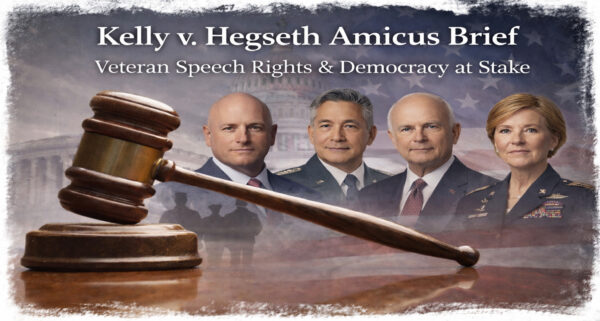
Who’s Who Behind the Amicus Brief and Why It Matters for Every Veteran

A powerful amicus curiae brief filed in Kelly v. Hegseth brings together an extraordinary coalition of former service secretaries, retired senior military leaders, and veteran advocates to deliver a unified warning to the court: punishing a retired service member for truthful public speech about military law threatens democratic self-government and chills the voices of millions of veterans nationwide.

This is not an abstract dispute about decorum or discipline. It is a case about who gets to speak, what the law actually requires, and whether veterans remain full participants in civic life after they hang up the uniform.

The Case at the Center

The lawsuit was brought by Mark Kelly, a retired U.S. Navy Captain and sitting U.S. Senator, after the Department of Defense took the unprecedented step of formally censuring him for public statements explaining a settled principle of military law: service members have a duty to disobey unlawful orders.

The defendant is Pete Hegseth, sued in his official capacity.

The amicus brief supports Senator Kelly’s request for a preliminary injunction, warning that allowing this punishment to stand would dramatically expand executive power over veteran speech.

Who Filed the Amicus Brief—and Why Their Voices Matter

Former Service Secretaries: Civilian Oversight at Stake

Among the amici are former civilian leaders entrusted with oversight of the armed forces, including:

  • Louis E. Caldera
  • Sean C. O’Keefe

Their participation signals that this case is not about politics—it is about preserving lawful civilian-military norms and constitutional boundaries.

Retired Generals and Admirals: Unmatched Military Authority

More than 40 retired senior officers across every branch of the armed forces signed the brief. Collectively, they served under every president from Dwight D. Eisenhower to Donald J. Trump.

Notable signatories include:

  • Antonio Taguba, known for leading the Abu Ghraib investigation
  • Michael V. Hayden, former Director of the CIA and NSA
  • Claudia J. Kennedy, the first woman to reach three-star rank in the Army
  • Thad W. Allen, former Commandant of the Coast Guard

These are not marginal critics. They are the leaders who trained troops, commanded forces, enforced military law, and safeguarded the institution’s credibility.

Veteran Civil Society: The Broader Impact

The brief is also joined by Vet Voice Foundation, a non-partisan organization representing nearly two million veterans and military family members.

Their involvement highlights the real-world consequences: when veteran speech is chilled, public debate suffers—and so does democratic accountability.

Counsel for the Amici

The amici are represented by leading democracy and constitutional-law organizations:

  • Protect Democracy Project
  • States United Democracy Center

What the Amicus Brief Argues—At a Glance

  1. Veteran Participation Is Essential to Democracy

Veterans serve throughout public life—as legislators, judges, journalists, educators, and advocates. Silencing them deprives the public of informed perspectives on national security and military policy.

  1. The Duty to Disobey Unlawful Orders Is Settled Law

The brief traces this principle through U.S. military case law, the Law of War, the Uniform Code of Military Justice, and post-World War II precedent. Explaining this duty publicly is accurate, lawful, and necessary, not misconduct.

  1. UCMJ Speech Limits Do Not Apply to This Case

Even for active-duty service members, speech may be restricted only where there is a direct and palpable connection to military mission or discipline. That standard is nowhere close to being met here—especially for a retired officer holding elected office.

If the government’s position were accepted, the brief warns, no meaningful First Amendment protection would remain for veterans.

Why This Moment Matters

The amici make clear that they filed this brief despite recognizing the risk of retaliation themselves. That chilling effect is the constitutional injury at the heart of this case.

If a retired service member can be punished for accurately explaining military law—then every veteran’s voice becomes conditional, subject to political approval.

This case is about more than one Senator. It is about whether service ends with silence—or whether veterans remain full participants in the democracy they defended.

Documents

Kelly amicus brief

1 Complaint Kelly v. Hegseth, 1.12.26

2 Kelly motion for emergency TRO and PI, 1.12.26

Amicus brief in support of Kelly, 1.20.26

4 Govt opposition to Kelly PI motion, 1.22.26 

Senator Kelly Reply brief in support of PI motion, 1.26.26

Citations & References

  • Brief of Amici Curiae Former Service Secretaries, Retired Senior Military Officers, and Vet Voice Foundation in Support of Plaintiff’s Motion for Preliminary Injunction and Stay, Kelly v. Hegseth, No. 1:26-cv-00081-RJL (D.D.C. Jan. 20, 2026). Kelly amicus brief
  • Uniform Code of Military Justice; Manual for Courts-Martial
  • United States v. Calley, 48 C.M.R. 19 (1973)
  • United States v. Huet-Vaughn, 43 M.J. 105 (C.A.A.F. 1995)
  • Department of Defense Law of War Manual

Constitution vs. Unlawful Retaliation: Why This Lawsuit Matters to Every Service Member

Gavel military judge

A constitutional line has been crossed, and every service member, veteran, and military family should be paying close attention.

In a newly filed federal lawsuit, a retired U.S. Navy service member, Arizona Senior Senator Mark Kelly, CAPT, USN (retired) is challenging what many legal experts are calling an unprecedented and unlawful act: a post-retirement demotion allegedly driven by political retaliation. The case, now drawing national attention, raises fundamental questions about free speech, civilian control, and the integrity of military justice itself.

As reported in Axios, Senior Military Defense Attorney Annie Morgan did not mince words in her assessment, calling the action “patently politically motivated” and warning that it represents a direct attack on long-standing constitutional protections afforded to both active-duty personnel and retirees.

A Dangerous Expansion of Power

At the center of the lawsuit is an effort reportedly tied to Pete Hegseth that seeks to retroactively punish a retired service member, someone no longer subject to the day-to-day authority of the chain of command. If allowed to stand, this move would represent a dramatic expansion of government power into territory that has historically been off-limits.

Military retirement is not a conditional privilege that can be revoked for disfavored speech. It is an earned status, grounded in decades of service and protected by constitutional principles. As Morgan explains, using rank demotion as a political weapon risks transforming military justice into a tool of retaliation rather than discipline.

The Chilling Effect on Free Speech

The implications extend far beyond one individual.

If retirees can be punished years later for expressing political views, criticizing government leadership, or participating in public discourse, the result will be a chilling effect across the entire military community. Active-duty service members, reservists, and veterans alike may reasonably fear that speaking out, even lawfully, could jeopardize their careers, benefits, or reputations.

That outcome cuts directly against the First Amendment and undermines the trust that service members must have in a fair, apolitical system of justice.

Why This Lawsuit Is a Line in the Sand

This case is not about politics; it is about limits.

It asks whether the government can reach backward in time to impose punishment on someone who has already completed honorable service. It challenges whether military authority ends at retirement, as the law has long recognized, or whether it can be revived whenever speech becomes inconvenient.

As covered in Axios, the lawsuit positions itself as a landmark challenge to government overreach, one that could set precedent for how far retaliation may go if left unchecked.

What Comes Next

Courts now have the opportunity and the responsibility to reaffirm that constitutional protections do not disappear at the end of active service. For veterans who have already given years, and often decades, to the nation, that assurance is not symbolic. It is essential.

This case will shape the future of military justice, free speech, and the relationship between service and citizenship.

Read the full Axios reporting here to understand why this lawsuit matters not just to one retired officer, but to every person who has worn the uniform.

A Season of Gratitude for Those Who Serve and Those Still Waiting

Sentiment for Holidays

As families gather during the holiday season, it is a time to pause and express gratitude—for service, for sacrifice, and for the quiet resilience of those who continue to serve even when recognition comes slowly, if at all.

Across the military and federal workforce, many service members and employees spend this time of year navigating unresolved challenges: pending medical evaluations, delayed retirement decisions, discharge reviews still under consideration, or careers placed on hold by administrative processes that move far more slowly than life itself. These are not abstract issues. They shape families’ futures, financial stability, and a sense of dignity earned through years of service.

This season invites reflection not only on what has been given, but on what is still owed—fair process, timely decisions, and lawful treatment. Gratitude does not require silence about the systems that affect those who serve. Instead, it can take the form of patient advocacy, careful attention to detail, and a commitment to ensuring that every case is reviewed on its merits.

For many, the holidays arrive without resolution. Yet service continues—often quietly, often unseen. Families adapt. Careers wait. And hope persists that the coming year will bring clarity, fairness, and accountability.

At this time of year, we extend our sincere thanks to service members, veterans, federal employees, and their families. Your service matters. Your patience is not unnoticed. And your right to fair treatment under the law remains essential—during the holidays and beyond.

After Years of Legal Barriers, Client Secures Critical Breakthrough in Mandamus Fight to Restore Full Appellate Review

DC Barrett Perryman Courthouse

In a case defined by extraordinary perseverance and complex jurisdictional obstacles, a former Guantanamo detainee represented by Senior Military Defense Attorney Annie W. Morgan of the Law Offices of David P. Sheldon, PLLC, has taken a major step forward in the effort to secure the full measure of appellate review guaranteed under federal law.

For more than a decade, the client has fought, often against procedural roadblocks not of their own making, to obtain a lawful review of their conviction by the United States Court of Military Commission Review (USCMCR), as required under 10 U.S.C. § 950f(d). Despite years of delay, shifting interpretations of waiver rules, repeated abeyances, and a novel assertion of the fugitive disentitlement doctrine, the client has refused to abandon the pursuit of lawful, congressionally mandated review.

Today’s development underscores one truth: the client’s courage, resilience, and insistence on the rule of law have kept this case alive when institutions failed to act.

A Story of Unusual Persistence in the Face of Systemic Delay

The client’s path to justice has been anything but direct. Though Congress established mandatory appellate review for military commission cases, the procedural history of this matter has been marked by:

  • Multiple delays and long periods of abeyance at the USCMCR
  • Government-created procedural roadblocks to obtain the record necessary for appeal, requiring mandamus intervention
  • A eventual dismissal based on the fugitive disentitlement doctrine, despite the client’s transfer being conducted under a formal diplomatic agreement—not flight, evasion, or refusal to appear and client remaining subject to lawful extradition

At every stage, the client remained steadfast. At every barrier, the client continued to assert the right Congress guarantees.

“This case has always been about ensuring that the Rule of Law is honored,” said Annie Morgan. “Our client has shown extraordinary strength in the face of procedural obstacles that should never have occurred. Their resilience is the reason we are still moving forward. And we will continue to fight until the statutory right to review is finally fulfilled.”

Why This Case Matters

This fight extends well beyond a single appeal. At its core, it speaks to:

  • The long-standing brokenness of the military commissions systems;
  • The duty of tribunals to exercise the jurisdiction Congress mandates; and
  • The fundamental principle that no person, no matter the forum, should lose their rights due to administrative delay or misapplied doctrine.

Congress was explicit:
The USCMCR “shall review the record in each case submitted to it.” (10 U.S.C. § 950f(d)).

When agencies fail to act, the courts must intervene. That is the purpose of mandamus—and the reason this client’s fight continues.

ABOUT THE LAW OFFICES OF DAVID P. SHELDON, PLLC

The Law Offices of David P. Sheldon, PLLC is a premier national practice focused on military law, federal employment, veteran’s rights, and the defense of service members across all uniformed services. Our team litigates before military commissions, federal courts, the Board for Correction of Military Records, the MSPB, and agencies across the United States. We are committed to protecting those who serve.

DISCLAIMER

This press release provides general information regarding ongoing litigation and does not offer legal advice. No confidential client details have been disclosed. Past results do not guarantee future outcomes.


Veteran Military Attorney Karen Hecker Rejoins the Law Offices of David P. Sheldon, PLLC

Karen Hecker joins Law Offices of David P Sheldon, PLLC

Veteran Military Attorney Karen Hecker Rejoins the Law Offices of David P. Sheldon, PLLC

Washington, D.C. – The Law Offices of David P. Sheldon, PLLC proudly announces the return of Karen Hecker, a distinguished military and federal litigation attorney, who brings more than four decades of combined legal experience in military justice, appellate defense, and federal agency counsel service.

Before retiring from federal service in 2025, Ms. Hecker served for 21 years as an Associate General Counsel with the Department of Defense Office of General Counsel, where she managed complex, high-impact litigation on behalf of the Department and its senior leadership. Her work spanned international law, personnel and health policy, fiscal matters, and military justice under the Uniform Code of Military Justice.

Karen’s government career followed 24 years as an Air Force Judge Advocate (JAG), culminating in her retirement as a Colonel in 2017 after service on active duty and in the Reserves. Her military tenure included three years as a trial defense counsel, which also involved representing cadets as Military Cadet Counsel at the United States Air Force Academy, followed by eight years as an appellate defense counsel, representing service members before both the Air Force Court of Criminal Appeals and the Court of Appeals for the Armed Forces.

She later served as Deputy Staff Judge Advocate and Staff Judge Advocate at two operational bases, and ultimately as a judge on the Air Force Court of Criminal Appeals, where she presided over military appellate cases. Before her retirement, Karen also served as agency counsel for the Air Force Board for Correction of Military Records and during Officer Grade Determination reviews.

Returning to the firm where she previously practiced from 2001 to 2004, Karen joins as a Senior Litigation Attorney, bringing exceptional insight and experience to the firm’s representation of military and federal employees across all branches of service.

“Karen’s return to our firm is a tremendous asset for our clients,” said David P. Sheldon, founder and principal attorney. “Her depth of experience, leadership, and integrity exemplify our mission—to deliver justice and restore honor to those who serve.”

In her personal time, Karen enjoys boating on the Chesapeake Bay and volunteering with a local animal rescue organization.