
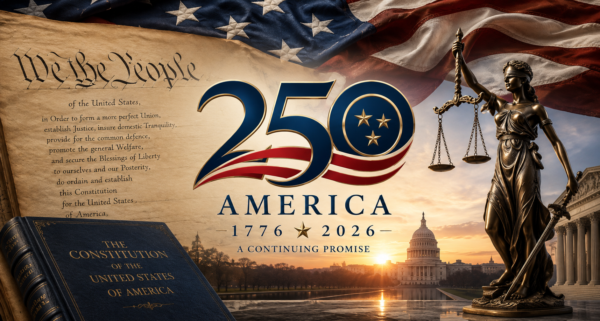
America at 250: Liberty, Service, and the Rule of Law

We The People 250th Celebration

250 Years of a Continuing Promise: Liberty, Service, and the Rule of Law

On July 4, 2026, the United States marks 250 years since the Continental Congress adopted the Declaration of Independence. It is a moment for celebration, certainly, but also for reflection. The Declaration did not promise that America would be perfect. It declared an enduring standard: that every person possesses inherent rights, that government derives its authority from the people, and that liberty must be protected against the abuse of power.

Two and a half centuries later, that promise still calls Americans to a shared responsibility.

The Declaration gave the nation its vision. The Constitution gave that vision structure. Its opening words, “We the People,” establish a government accountable to the people it serves, one designed to establish justice, provide for the common defense, and secure liberty for future generations. The Bill of Rights reinforced that commitment by placing meaningful limits on government power and protecting individual freedoms.

These principles do not belong to one political party, one profession, one generation, or one community. They belong to all Americans.

They are carried forward by those who serve in uniform and take an oath to support and defend the Constitution. They are carried forward by veterans who have already borne the weight of service, by federal employees who carry out the everyday work of government, and by families who support those called to serve. They are also carried forward by citizens who vote, speak, listen, advocate, serve their communities, and insist that our institutions live up to the standards they were created to uphold.

The defenders of the Constitution are not only found on a battlefield or in a courtroom. They are found wherever Americans choose principle over convenience, fairness over indifference, and accountability over unchecked authority.

That is what makes this anniversary meaningful.

The rule of law is not an abstract idea reserved for history books or ceremonial speeches. It is felt in the real lives of people: in whether a service member receives due process; whether a veteran is treated with dignity; whether a federal employee is judged fairly; whether a whistleblower can raise concerns without unlawful retaliation; whether a family is heard when government action changes the course of a life.

For those who have served the nation, constitutional protections must be more than words. Fair process, complete records, lawful decision-making, meaningful review, and respect for individual rights are essential to the trust that binds a citizen to government. When that trust is honored, the nation is stronger. When it is disregarded, Americans have both the right and the responsibility to seek accountability through the lawful institutions our constitutional system provides.

This is not a partisan commitment. It is a civic one.

America’s history includes extraordinary achievement, profound sacrifice, and difficult chapters that remind us that the promise of liberty and justice for all is never self-executing. Each generation inherits both the benefits of freedom and the duty to protect it. The Constitution does not ask Americans to be passive observers of their democracy. It asks us to remain engaged, to preserve rights, respect one another’s humanity, and demand that public power be exercised lawfully and responsibly.

At the Law Offices of David P. Sheldon, PLLC, we see the continuing importance of those principles in the lives of the people we serve. Our work often begins when someone feels unheard by a system, burdened by an unfair decision, or uncertain whether the rights they earned through service will be respected. In those moments, the promise of the Constitution becomes deeply personal.

On this 250th anniversary of American independence, we honor those who have defended the nation in uniform, those who serve it in public life, and all Americans who continue the work of building a more just union.

The nation’s founding promise remains unfinished only if we stop striving toward it.

May this Independence Day be a time to remember what liberty requires: courage, service, accountability, and a continued commitment to justice for all.

“America’s founding documents set a standard that remains as important today as it was 250 years ago: government must be accountable to the people, and individual rights must be protected under the law. This July 4, we honor those who have served to defend that promise and renew our commitment to ensuring it remains meaningful for every person whose life is affected by government action.”
David P. Sheldon, Founder, Law Offices of David P. Sheldon, PLLC

About the Law Offices of David P. Sheldon, PLLC

The Law Offices of David P. Sheldon, PLLC represents service members, veterans, federal employees, and other individuals navigating military, federal, and administrative legal matters. The firm is committed to principled advocacy, due process, and the protection of rights under law.

Disclaimer

This article is provided for general informational and educational purposes only. It is not legal advice and does not create an attorney-client relationship. Every legal matter depends on its individual facts, governing law, and procedural posture.

References

The National Archives recognizes July 4, 1776, as the date the Continental Congress adopted the Declaration of Independence.

The National Archives’ founding-document resources describe the Declaration as expressing the ideals on which the United States was founded, the Constitution as establishing the framework of the federal government, and the Bill of Rights as defining rights in relation to government.

Physicians Seek Accountability After Dismissed Federal Case Leaves Lasting Professional Damage

Federal Lawsuit Challenges Government Records, Press Releases, and Background Reports That Plaintiffs Allege Continue to Destroy Their Careers

The Law Offices of David P. Sheldon, PLLC has filed a federal lawsuit in the United States District Court for the District of Maryland on behalf of Dr. Jamie Lee Henry and Dr. Anna Gabrielian, seeking damages and injunctive relief under the Privacy Act of 1974 and the Fifth Amendment after what the complaint alleges was years of reputational harm caused by inaccurate and misleading government records.

The complaint follows one of the most widely publicized federal prosecutions involving medical professionals in recent years, a prosecution that ultimately ended with all criminal charges dismissed with prejudice after the Court found violations of the Speedy Trial Act.

Yet according to the newly filed civil action, the dismissal did not end the consequences.

Instead, the lawsuit alleges that government press releases, practitioner databases, and federal background screening systems continued to portray the physicians as individuals facing national security allegations long after the case had been permanently dismissed, effectively preventing them from rebuilding their professional lives.

When an Acquittal Isn’t Enough

For physicians, reputation is more than a personal asset, it is a professional credential.

Every hospital appointment, medical license, credentialing review, military privilege, and employment opportunity depends upon the accuracy of federal records and background investigations.

The complaint alleges that despite the dismissal of every criminal charge, government records continued to circulate allegations suggesting disloyalty to the United States, national security concerns, and professional misconduct.

According to the complaint, these records appeared in:

  • Department of Justice press releases
  • Federal practitioner databases
  • Background screening systems relied upon by hospitals
  • Credentialing organizations
  • State licensing authorities
  • Healthcare employers nationwide

The lawsuit contends that those records continued to produce devastating professional consequences long after the criminal case had ended.

A Career Built on Service

Dr. Jamie Lee Henry served nearly twenty years as an Army physician, caring for service members and their families while conducting infectious disease research and participating in humanitarian medical efforts around the world.

Dr. Anna Gabrielian built her career as an anesthesiologist at Johns Hopkins, contributing to maternal health initiatives, medical education, battlefield medicine projects for Ukraine, and international humanitarian programs.

The complaint details decades of public service, military medicine, research, and volunteer efforts that plaintiffs argue stand in stark contrast to the narrative created by the government’s public statements.

Dismissed With Prejudice, but the Story Continued

The underlying criminal prosecution concluded when the United States District Court dismissed every charge with prejudice after finding violations of the Speedy Trial Act.

According to the complaint, the Court described:

  • the allegations as “highly unusual,”
  • the medical records involved as “relatively inconsequential,”
  • and expressed “grave concerns” regarding the government’s handling of the prosecution.

Despite that dismissal, the lawsuit alleges that a DOJ press release remained publicly available for nearly two years without reflecting the final disposition of the case and continued to contain statements suggesting the physicians were “facing federal indictment.”

The complaint further alleges that the government eventually added only a brief notation acknowledging dismissal while leaving the original narrative and allegations substantially intact.

The Lasting Effect of Digital Government Records

Unlike traditional news coverage, government press releases frequently become permanent source material for:

  • background investigations,
  • credentialing databases,
  • licensing reviews,
  • compliance screening,
  • hospital hiring decisions,
  • and practitioner reporting systems.

The lawsuit alleges that those records were incorporated into healthcare screening systems that continued to identify Dr. Gabrielian as facing federal indictment months after dismissal and continued to affect employment opportunities nationwide.

The complaint similarly challenges a National Practitioner Data Bank report affecting Dr. Henry, arguing that it failed to accurately reflect the dismissal of the underlying criminal allegations while characterizing the matter as professional misconduct.

A Case About Due Process in the Digital Age

While the complaint seeks substantial monetary damages, it is equally focused on correcting government records.

The lawsuit raises broader questions about:

  • the government’s responsibility to maintain accurate public records,
  • whether outdated accusations should remain permanently accessible after dismissal,
  • and how inaccurate federal information can continue to affect professional licensing, employment, and constitutional liberty interests.

As public information increasingly becomes permanent digital history, the lawsuit asks whether government agencies have an obligation to ensure that dismissed allegations are not indefinitely presented as current facts.

Statement from Counsel

“A dismissed case should not become a permanent professional sentence. Our clients dedicated their lives to healing others and serving their country. When government records continue to publish allegations after the justice system has spoken, the damage extends far beyond the courtroom. This lawsuit seeks accountability, correction of the public record, and restoration of rights that should never have been lost.” David P. Sheldon, Founding Attorney

About the Law Offices of David P. Sheldon, PLLC

The Law Offices of David P. Sheldon, PLLC represents military service members, federal employees, physicians, healthcare professionals, veterans, and uniformed personnel before federal courts, administrative agencies, licensing authorities, military correction boards, and appellate tribunals throughout the United States. The firm is committed to protecting constitutional rights, professional licenses, careers, and reputations.

Disclaimer

This press release is provided for informational purposes only and does not constitute legal advice or establish an attorney-client relationship. The allegations described are contained in a publicly filed civil complaint. All defendants are entitled to respond to those allegations, and the claims remain subject to judicial determination.


When Care Is Afloat, Accountability Cannot End at the Waterline

When Care Is Afloat, Accountability Cannot End at the Waterline

Law Offices of David P. Sheldon, PLLC Files D.C. Circuit Appeal Challenging DoD Rule That Bars Shipboard Military Medical-Malpractice Claims

When a service member is deployed at sea, medical care is not optional. The military medical department aboard the ship is often the only available source of treatment. A new appeal filed in the U.S. Court of Appeals for the District of Columbia Circuit asks whether the Department of Defense may nevertheless deny a military medical-malpractice claim simply because the care occurred aboard a ship.

The Law Offices of David P. Sheldon, PLLC represents Plaintiff-Appellant Derrick Luckey in Luckey v. Hegseth, No. 26-5094. On June 30, 2026, the firm filed its principal appellate brief seeking reversal of the District Court’s dismissal of Mr. Luckey’s challenge to the Department of Defense’s denial of a claim arising from the death of his daughter, Navy Seaman Danyelle Luckey.

According to the filing, Seaman Luckey became seriously ill while deployed aboard the USS Ronald Reagan in October 2016. The brief alleges that she repeatedly sought treatment through the ship’s medical department as her condition deteriorated, and that she later died after allegedly inadequate medical care aboard the vessel. The appeal does not ask the D.C. Circuit to determine whether medical malpractice occurred. Instead, it asks whether the Department of Defense may prevent the claim from being reviewed under the statutory process Congress created for military medical-malpractice claims.

At issue is the SFC Richard Stayskal Military Medical Accountability Act, codified at 10 U.S.C. § 2733a. The law permits certain administrative claims by service members, or authorized representatives on their behalf, when medical malpractice occurs in a covered military medical treatment facility. The appeal argues that the Department of Defense’s implementing regulation, 32 C.F.R. § 45.5(b)(2), unlawfully excludes medical care provided aboard ships from that process.

The firm’s filing maintains that Congress did not create a blanket exemption for ships. It argues that a naval medical department providing care to thousands of deployed service members, in a setting where civilian medical care is unavailable, should not be treated as outside the reach of a law intended to provide accountability for military medical negligence.

The appeal also raises a separate issue involving the deadline for filing a claim. The governing regulation incorporates a discovery rule, providing that a claim accrues when a claimant knew, or reasonably should have known, of both the injury and that malpractice was a possible cause. Mr. Luckey’s filing argues that the Department of Defense failed to apply that rule fairly where official records initially identified his daughter’s death as resulting from natural causes and an independent expert opinion later identified alleged medical negligence as a possible cause.

The District Court dismissed the case on January 29, 2026, concluding that the Military Claims Act’s finality provision barred judicial review. The appeal asks the D.C. Circuit to apply the established exception permitting review when an agency has misconstrued governing law, departed from important procedural protections, or committed an error that goes to the heart of the administrative determination.

“Service members deployed at sea cannot simply choose another hospital when military medical care is the only care available,” said David P. Sheldon, founder of the Law Offices of David P. Sheldon, PLLC. “Congress created a pathway for accountability in military medical malpractice matters. This appeal asks whether that pathway can be closed simply because the care occurred on a ship.”

The questions raised by Luckey v. Hegseth extend beyond one family. Service members receive medical care in operational settings every day, aboard ships, in aircraft, during deployments, and far from civilian hospitals. The outcome may help define whether the protections Congress established for military medical-malpractice claims apply where military medicine is most essential and least replaceable.

The Law Offices of David P. Sheldon, PLLC will continue to advocate for meaningful accountability, fair administrative process, and access to justice for service members and families affected by alleged failures in military medical care.

About the Law Offices of David P. Sheldon, PLLC

The Law Offices of David P. Sheldon, PLLC represents service members, veterans, federal employees, and their families in complex military, federal administrative, appellate, and constitutional matters. The firm advocates for clients facing high-stakes issues involving military justice, military medical care, records corrections, disability matters, federal employment, and government accountability.

Disclaimer

This article is provided for general informational purposes only and does not constitute legal advice. It describes allegations and legal arguments contained in a pending appeal. No court has determined that medical malpractice occurred in this matter, and past results do not guarantee a similar outcome in any future case.