
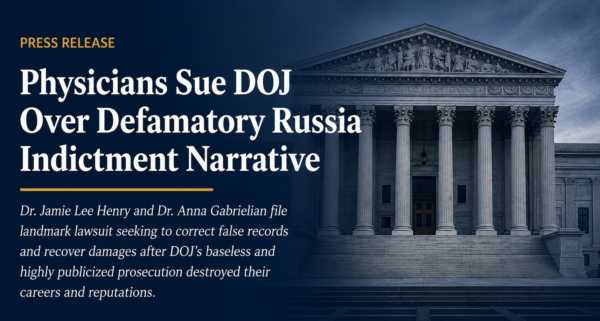
Federal Lawsuit Challenges Government Records, Press Releases, and Background Reports That Plaintiffs Allege Continue to Destroy Their Careers
The Law Offices of David P. Sheldon, PLLC has filed a federal lawsuit in the United States District Court for the District of Maryland on behalf of Dr. Jamie Lee Henry and Dr. Anna Gabrielian, seeking damages and injunctive relief under the Privacy Act of 1974 and the Fifth Amendment after what the complaint alleges was years of reputational harm caused by inaccurate and misleading government records.
The complaint follows one of the most widely publicized federal prosecutions involving medical professionals in recent years, a prosecution that ultimately ended with all criminal charges dismissed with prejudice after the Court found violations of the Speedy Trial Act.
Yet according to the newly filed civil action, the dismissal did not end the consequences.
Instead, the lawsuit alleges that government press releases, practitioner databases, and federal background screening systems continued to portray the physicians as individuals facing national security allegations long after the case had been permanently dismissed, effectively preventing them from rebuilding their professional lives.
When an Acquittal Isn’t Enough
For physicians, reputation is more than a personal asset, it is a professional credential.
Every hospital appointment, medical license, credentialing review, military privilege, and employment opportunity depends upon the accuracy of federal records and background investigations.
The complaint alleges that despite the dismissal of every criminal charge, government records continued to circulate allegations suggesting disloyalty to the United States, national security concerns, and professional misconduct.
According to the complaint, these records appeared in:
- Department of Justice press releases
- Federal practitioner databases
- Background screening systems relied upon by hospitals
- Credentialing organizations
- State licensing authorities
- Healthcare employers nationwide
The lawsuit contends that those records continued to produce devastating professional consequences long after the criminal case had ended.
A Career Built on Service
Dr. Jamie Lee Henry served nearly twenty years as an Army physician, caring for service members and their families while conducting infectious disease research and participating in humanitarian medical efforts around the world.
Dr. Anna Gabrielian built her career as an anesthesiologist at Johns Hopkins, contributing to maternal health initiatives, medical education, battlefield medicine projects for Ukraine, and international humanitarian programs.
The complaint details decades of public service, military medicine, research, and volunteer efforts that plaintiffs argue stand in stark contrast to the narrative created by the government’s public statements.
Dismissed With Prejudice, but the Story Continued
The underlying criminal prosecution concluded when the United States District Court dismissed every charge with prejudice after finding violations of the Speedy Trial Act.
According to the complaint, the Court described:
- the allegations as “highly unusual,”
- the medical records involved as “relatively inconsequential,”
- and expressed “grave concerns” regarding the government’s handling of the prosecution.
Despite that dismissal, the lawsuit alleges that a DOJ press release remained publicly available for nearly two years without reflecting the final disposition of the case and continued to contain statements suggesting the physicians were “facing federal indictment.”
The complaint further alleges that the government eventually added only a brief notation acknowledging dismissal while leaving the original narrative and allegations substantially intact.
The Lasting Effect of Digital Government Records
Unlike traditional news coverage, government press releases frequently become permanent source material for:
- background investigations,
- credentialing databases,
- licensing reviews,
- compliance screening,
- hospital hiring decisions,
- and practitioner reporting systems.
The lawsuit alleges that those records were incorporated into healthcare screening systems that continued to identify Dr. Gabrielian as facing federal indictment months after dismissal and continued to affect employment opportunities nationwide.
The complaint similarly challenges a National Practitioner Data Bank report affecting Dr. Henry, arguing that it failed to accurately reflect the dismissal of the underlying criminal allegations while characterizing the matter as professional misconduct.
A Case About Due Process in the Digital Age
While the complaint seeks substantial monetary damages, it is equally focused on correcting government records.
The lawsuit raises broader questions about:
- the government’s responsibility to maintain accurate public records,
- whether outdated accusations should remain permanently accessible after dismissal,
- and how inaccurate federal information can continue to affect professional licensing, employment, and constitutional liberty interests.
As public information increasingly becomes permanent digital history, the lawsuit asks whether government agencies have an obligation to ensure that dismissed allegations are not indefinitely presented as current facts.
Statement from Counsel
“A dismissed case should not become a permanent professional sentence. Our clients dedicated their lives to healing others and serving their country. When government records continue to publish allegations after the justice system has spoken, the damage extends far beyond the courtroom. This lawsuit seeks accountability, correction of the public record, and restoration of rights that should never have been lost.” David P. Sheldon, Founding Attorney
About the Law Offices of David P. Sheldon, PLLC
The Law Offices of David P. Sheldon, PLLC represents military service members, federal employees, physicians, healthcare professionals, veterans, and uniformed personnel before federal courts, administrative agencies, licensing authorities, military correction boards, and appellate tribunals throughout the United States. The firm is committed to protecting constitutional rights, professional licenses, careers, and reputations.
Disclaimer
This press release is provided for informational purposes only and does not constitute legal advice or establish an attorney-client relationship. The allegations described are contained in a publicly filed civil complaint. All defendants are entitled to respond to those allegations, and the claims remain subject to judicial determination.