
Physicians Seek Accountability After Dismissed Federal Case Leaves Lasting Professional Damage

Federal Lawsuit Challenges Government Records, Press Releases, and Background Reports That Plaintiffs Allege Continue to Destroy Their Careers

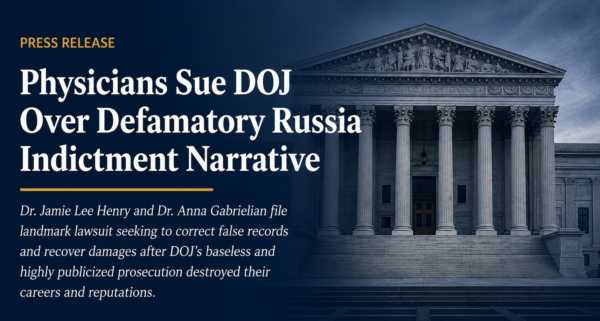
The Law Offices of David P. Sheldon, PLLC has filed a federal lawsuit in the United States District Court for the District of Maryland on behalf of Dr. Jamie Lee Henry and Dr. Anna Gabrielian, seeking damages and injunctive relief under the Privacy Act of 1974 and the Fifth Amendment after what the complaint alleges was years of reputational harm caused by inaccurate and misleading government records.

The complaint follows one of the most widely publicized federal prosecutions involving medical professionals in recent years, a prosecution that ultimately ended with all criminal charges dismissed with prejudice after the Court found violations of the Speedy Trial Act.

Yet according to the newly filed civil action, the dismissal did not end the consequences.

Instead, the lawsuit alleges that government press releases, practitioner databases, and federal background screening systems continued to portray the physicians as individuals facing national security allegations long after the case had been permanently dismissed, effectively preventing them from rebuilding their professional lives.

When an Acquittal Isn’t Enough

For physicians, reputation is more than a personal asset, it is a professional credential.

Every hospital appointment, medical license, credentialing review, military privilege, and employment opportunity depends upon the accuracy of federal records and background investigations.

The complaint alleges that despite the dismissal of every criminal charge, government records continued to circulate allegations suggesting disloyalty to the United States, national security concerns, and professional misconduct.

According to the complaint, these records appeared in:

  • Department of Justice press releases
  • Federal practitioner databases
  • Background screening systems relied upon by hospitals
  • Credentialing organizations
  • State licensing authorities
  • Healthcare employers nationwide

The lawsuit contends that those records continued to produce devastating professional consequences long after the criminal case had ended.

A Career Built on Service

Dr. Jamie Lee Henry served nearly twenty years as an Army physician, caring for service members and their families while conducting infectious disease research and participating in humanitarian medical efforts around the world.

Dr. Anna Gabrielian built her career as an anesthesiologist at Johns Hopkins, contributing to maternal health initiatives, medical education, battlefield medicine projects for Ukraine, and international humanitarian programs.

The complaint details decades of public service, military medicine, research, and volunteer efforts that plaintiffs argue stand in stark contrast to the narrative created by the government’s public statements.

Dismissed With Prejudice, but the Story Continued

The underlying criminal prosecution concluded when the United States District Court dismissed every charge with prejudice after finding violations of the Speedy Trial Act.

According to the complaint, the Court described:

  • the allegations as “highly unusual,”
  • the medical records involved as “relatively inconsequential,”
  • and expressed “grave concerns” regarding the government’s handling of the prosecution.

Despite that dismissal, the lawsuit alleges that a DOJ press release remained publicly available for nearly two years without reflecting the final disposition of the case and continued to contain statements suggesting the physicians were “facing federal indictment.”

The complaint further alleges that the government eventually added only a brief notation acknowledging dismissal while leaving the original narrative and allegations substantially intact.

The Lasting Effect of Digital Government Records

Unlike traditional news coverage, government press releases frequently become permanent source material for:

  • background investigations,
  • credentialing databases,
  • licensing reviews,
  • compliance screening,
  • hospital hiring decisions,
  • and practitioner reporting systems.

The lawsuit alleges that those records were incorporated into healthcare screening systems that continued to identify Dr. Gabrielian as facing federal indictment months after dismissal and continued to affect employment opportunities nationwide.

The complaint similarly challenges a National Practitioner Data Bank report affecting Dr. Henry, arguing that it failed to accurately reflect the dismissal of the underlying criminal allegations while characterizing the matter as professional misconduct.

A Case About Due Process in the Digital Age

While the complaint seeks substantial monetary damages, it is equally focused on correcting government records.

The lawsuit raises broader questions about:

  • the government’s responsibility to maintain accurate public records,
  • whether outdated accusations should remain permanently accessible after dismissal,
  • and how inaccurate federal information can continue to affect professional licensing, employment, and constitutional liberty interests.

As public information increasingly becomes permanent digital history, the lawsuit asks whether government agencies have an obligation to ensure that dismissed allegations are not indefinitely presented as current facts.

Statement from Counsel

“A dismissed case should not become a permanent professional sentence. Our clients dedicated their lives to healing others and serving their country. When government records continue to publish allegations after the justice system has spoken, the damage extends far beyond the courtroom. This lawsuit seeks accountability, correction of the public record, and restoration of rights that should never have been lost.” David P. Sheldon, Founding Attorney

About the Law Offices of David P. Sheldon, PLLC

The Law Offices of David P. Sheldon, PLLC represents military service members, federal employees, physicians, healthcare professionals, veterans, and uniformed personnel before federal courts, administrative agencies, licensing authorities, military correction boards, and appellate tribunals throughout the United States. The firm is committed to protecting constitutional rights, professional licenses, careers, and reputations.

Disclaimer

This press release is provided for informational purposes only and does not constitute legal advice or establish an attorney-client relationship. The allegations described are contained in a publicly filed civil complaint. All defendants are entitled to respond to those allegations, and the claims remain subject to judicial determination.


Supreme Court Petition Challenges Limits of Executive Authority Over Military Promotions

SCOTUS Appeal

Former Navy Officer Seeks Supreme Court Review of D.C. Circuit Decision Interpreting 10 U.S.C. § 624(d)(5)

The Law Offices of David P. Sheldon, PLLC filed a Petition for Writ of Certiorari asking the Supreme Court of the United States to review a significant military personnel law case involving the interpretation of federal promotion statutes, Congressional authority over the armed forces, and the constitutional balance between the legislative and executive branches.

The petition was filed on behalf of Lieutenant Ernest F. Mitchell, U.S. Navy, who challenges decisions by the Board for Correction of Naval Records, the U.S. District Court for the District of Columbia, and the U.S. Court of Appeals for the D.C. Circuit concerning the Navy’s handling of his promotion to Lieutenant Commander. The petition presents a single constitutional question: whether the courts improperly nullified Congress’s express statutory limitation on military promotion delays contained in 10 U.S.C. § 624(d)(5).

The Supreme Court filing follows the D.C. Circuit’s March 13, 2026 decision affirming the lower court’s ruling that Lieutenant Mitchell was not promoted “by operation of law” despite remaining on the promotion list beyond the statutory 18-month limitation established by Congress.

A Question Affecting Military Officers Across the Armed Forces

At the heart of the petition is a straightforward question with potentially broad implications for military personnel:

Congress enacted a statute providing that an officer’s appointment “may not be delayed” beyond eighteen months after the date the officer otherwise would have been appointed. Lieutenant Mitchell argues that when the government exceeds that statutory deadline, Congress intended the promotion process to conclude and the appointment to take effect. The petition contends that the D.C. Circuit’s interpretation effectively reads the statutory deadline out of existence and leaves military officers without a meaningful remedy when the government violates the law.

The petition further argues that the case presents an important separation-of-powers issue involving Congress’s constitutional authority to “make Rules for the Government and Regulation of the land and naval Forces.”

Representation

Lieutenant Mitchell continues to be represented by David P. Sheldon, founder of the Law Offices of David P. Sheldon, PLLC.

What the Legal Team Expects to Advance

The Supreme Court petition seeks more than relief for a single officer. The case presents an opportunity for the Court to clarify:

  • Whether Congress may impose enforceable deadlines on military promotion delays;
  • Whether courts may effectively nullify statutory protections by finding no remedy for an acknowledged violation;
  • The proper balance between Congressional authority over military personnel systems and executive appointment powers;
  • The rights of service members who have been nominated, Senate-confirmed, and then subjected to administrative delays beyond limits established by federal law.

The case presents a recurring question affecting thousands of military officers whose careers, promotions, retirement calculations, and future opportunities may depend upon the faithful application of federal promotion statutes. The petition argues that only the Supreme Court can provide uniform guidance on the meaning and enforceability of 10 U.S.C. § 624(d)(5).

Statement from the Legal Team

“This petition asks whether statutory protections enacted by Congress have real force or merely symbolic value,” said David P. Sheldon. “When Congress establishes a deadline governing military promotions, service members deserve to know whether that deadline means what it says. We believe this case presents an important constitutional question worthy of Supreme Court review.”

About the Law Offices of David P. Sheldon, PLLC

The Law Offices of David P. Sheldon, PLLC represents military service members, veterans, federal employees, and uniformed service professionals worldwide in courts-martial, military administrative proceedings, correction board matters, security clearance cases, federal employment disputes, appellate litigation, and federal court actions.

For more information, visit www.militarydefense.com.

Disclaimer

The materials contained in this release are provided for informational purposes only and do not constitute legal advice. Filing a petition for certiorari does not guarantee Supreme Court review. Every case is unique, and prior results do not guarantee future outcomes. Reading this release does not create an attorney-client relationship.


Veteran Military Attorney Karen Hecker Rejoins the Law Offices of David P. Sheldon, PLLC

Karen Hecker joins Law Offices of David P Sheldon, PLLC

Veteran Military Attorney Karen Hecker Rejoins the Law Offices of David P. Sheldon, PLLC

Washington, D.C. – The Law Offices of David P. Sheldon, PLLC proudly announces the return of Karen Hecker, a distinguished military and federal litigation attorney, who brings more than four decades of combined legal experience in military justice, appellate defense, and federal agency counsel service.

Before retiring from federal service in 2025, Ms. Hecker served for 21 years as an Associate General Counsel with the Department of Defense Office of General Counsel, where she managed complex, high-impact litigation on behalf of the Department and its senior leadership. Her work spanned international law, personnel and health policy, fiscal matters, and military justice under the Uniform Code of Military Justice.

Karen’s government career followed 24 years as an Air Force Judge Advocate (JAG), culminating in her retirement as a Colonel in 2017 after service on active duty and in the Reserves. Her military tenure included three years as a trial defense counsel, which also involved representing cadets as Military Cadet Counsel at the United States Air Force Academy, followed by eight years as an appellate defense counsel, representing service members before both the Air Force Court of Criminal Appeals and the Court of Appeals for the Armed Forces.

She later served as Deputy Staff Judge Advocate and Staff Judge Advocate at two operational bases, and ultimately as a judge on the Air Force Court of Criminal Appeals, where she presided over military appellate cases. Before her retirement, Karen also served as agency counsel for the Air Force Board for Correction of Military Records and during Officer Grade Determination reviews.

Returning to the firm where she previously practiced from 2001 to 2004, Karen joins as a Senior Litigation Attorney, bringing exceptional insight and experience to the firm’s representation of military and federal employees across all branches of service.

“Karen’s return to our firm is a tremendous asset for our clients,” said David P. Sheldon, founder and principal attorney. “Her depth of experience, leadership, and integrity exemplify our mission—to deliver justice and restore honor to those who serve.”

In her personal time, Karen enjoys boating on the Chesapeake Bay and volunteering with a local animal rescue organization.