
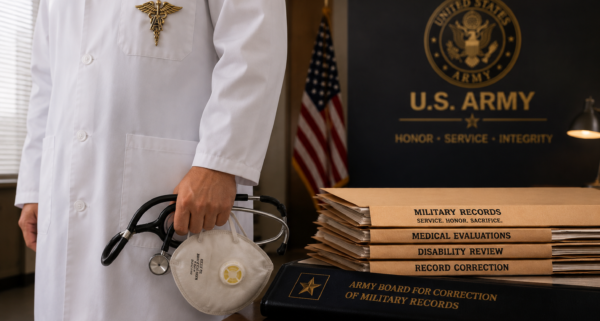
Army Medical Officer Asks ABCMR to Correct Decades Old Disability Retirement Record

Army Medical Officer Asks ABCMR to Correct Decades Old Disability Retirement Record

Filing Seeks Review of Disability Rating, Retirement Processing and Long-Term Consequences of an Army Medical Separation

The Law Offices of David P. Sheldon, PLLC has applied to the Army Board for Correction of Military Records (ABCMR) on behalf of a former Army medical officer seeking correction of records arising from a disability retirement process that began more than two decades ago.

The application asks the ABCMR to correct the former officer’s military records to reflect a 100% disability rating at the time of medical retirement, together with back pay and any benefits or entitlements resulting from that correction. Alternatively, the filing asks that the records be corrected to reflect retirement under the Temporary Early Retirement Authority (TERA) and requests any other relief the Board determines to be just and appropriate.

At the center of the case is an Army medical professional whose career, according to the filing, was distinguished by years of superior evaluations, demanding clinical responsibilities and military service that included support of Operations Desert Shield and Desert Storm.

The application describes an officer who served both as a nurse and certified registered nurse anesthetist and who repeatedly received exceptionally favorable professional evaluations. The record cited in the filing reflects top performance and promotion recommendations from multiple raters and senior raters throughout the officer’s career.

The filing further states that the officer received numerous military awards and professional recognitions and that a review of the evaluation record revealed no negative performance remarks or departures from the highest evaluation standards before the medical-disability process altered the course of the officer’s career.

From a Finding of Fitness to Disability Retirement

The case traces a complicated history through the Army’s disability evaluation system.

According to the application, an initial Physical Evaluation Board in 1998 determined that the officer remained physically fit to perform military duties. A later evaluation resulted in a substantially different outcome.

In March 2002, a second Physical Evaluation Board found the officer unfit for continued military service and recommended placement on the Temporary Disability Retired List (TDRL) with a 30% disability rating because the medical condition was not considered sufficiently stable for final adjudication. The officer was subsequently placed on the TDRL after more than 15 years of active-duty service. The filing states that a Department of Veterans Affairs disability rating for the underlying condition was initially 30% and later increased to 100%, effective in 2018.

The application does not contend that a later VA rating automatically establishes an error by the Army. Instead, it asks the ABCMR to consider the entire historical record, including the evolving medical understanding of the condition and the circumstances surrounding the original military disability determination.

Questions Surrounding the Permanent Retirement Decision

One of the central arguments presented to the ABCMR concerns what happened while the officer remained on the TDRL.

The application argues that the medical record continued to reflect uncertainty and disagreement concerning symptoms, diagnosis and treatment and that the condition had not been adequately established as permanent and stable when the officer was removed from the TDRL and permanently retired.

The filing contends that this processing deprived the officer of a meaningful opportunity to pursue another retirement path that was available during the relevant period, including retirement under TERA.

That distinction matters because the requested record correction could affect not simply the characterization of events decades ago, but the retirement benefits available to the former officer today.

The filing also explains that subsequent denials of Combat-Related Special Compensation have affected the interaction between military retirement pay and VA disability compensation. The application therefore asks the Board to examine the consequences of the original retirement processing in the context of the full record rather than viewing the original disability percentage in isolation.

Professional Consequences Beyond Retirement Pay

The application also asks the ABCMR to consider the broader professional consequences that followed the officer’s medical difficulties.

The filing describes the suspension of the officer’s clinical privileges while serving as a military medical professional. It argues that the resulting credentialing history produced consequences extending far beyond separation from the Army because healthcare professionals may face continuing disclosure obligations concerning adverse credentialing actions.

Significantly, the filing states that the underlying records repeatedly indicated that patient care had not been adversely affected. Nevertheless, according to the application, the credentialing action had lasting consequences for the officer’s ability to continue working in the medical profession.

The case therefore presents the ABCMR with a question that extends beyond a historical disability percentage: whether the complete record now demonstrates an error or injustice warranting correction under the Board’s equitable authority.

Asking the ABCMR to Examine the Complete Record

The application acknowledges that the request comes many years after the underlying military decisions. It asks the ABCMR to excuse that delay in the interest of justice, pointing both to the applicant’s circumstances and to the difficulty of reconstructing military records that were not centrally available.

The filing argues that the strength of the underlying claim should be considered when determining whether the Board should reach the merits despite the passage of time.

Ultimately, the case asks the Board to look at an entire military career rather than a single moment in the disability process: years of strong performance, medical evaluations that changed over time, placement on the TDRL, permanent retirement, subsequent disability developments and the long-term financial and professional consequences of those decisions.

The application asks the ABCMR to correct the former officer’s Army records to reflect a 100% disability rating at the time of medical retirement or, alternatively, TERA retirement, together with the corrections, back pay and entitlements necessary to implement whatever relief the Board grants.

Fleming Keefe, Litigation Attorney, Law Offices of David P. Sheldon, PLLC, who drafted and submitted the comprehensive submission, concluded: “Boards for Correction of Military Records exist because decisions made years ago can continue to affect a service member long after the uniform comes off. This application asks the Army to examine the complete record of the officer’s service, medical history, disability processing and the consequences that followed  and determine whether justice now requires a correction.”

ABOUT THE LAW OFFICES OF DAVID P. SHELDON, PLLC

The Law Offices of David P. Sheldon, PLLC, based in Washington, D.C., represents service members, veterans and federal employees in matters involving military and federal law. The firm handles complex matters involving military records corrections, disability evaluation and retirement proceedings, administrative actions, military appeals and federal litigation.

For additional information about the firm and its military law practice, visit MilitaryDefense.com.

Law Offices of David P. Sheldon, PLLC
100 M Street SE, Suite 600
Washington, DC 20003
202-546-9575

DISCLAIMER

This release concerns allegations and legal arguments contained in an application submitted to the Army Board for Correction of Military Records. The filing represents the applicant’s position, and no determination by the ABCMR should be inferred from the filing of the application.

This material is provided for general informational and educational purposes only and does not constitute legal advice. Past results do not guarantee or predict future outcomes. Every military or federal administrative matter depends upon its individual facts, governing law and procedural history.

Certain identifying information has been intentionally withheld to protect the privacy of the applicant.

© 2026 Law Offices of David P. Sheldon, PLLC. All rights reserved.



After a Decade of Waiting, Former Army Officer Finally Wins Long-Overdue Retirement Relief

Army reservist receives justice

For more than ten years, a dedicated Army Reserve officer lived under the weight of a decision that abruptly ended her career just months before she reached the crucial milestone needed to secure her earned retirement. Today, that chapter finally closes and a new one begins.

On November 18, 2025, the U.S. Army Human Resources Command formally notified her that her request for a Mandatory Removal Date (MRD) extension has been approved and that the Army has corrected her records to reflect completion of 20 years of qualifying service. The Army simultaneously issued her long-delayed 20-year retirement letter and revoked her 2015 discharge order, clearing the way for her to receive her retirement benefits at last.

This outcome comes after the United States District Court for the District of Columbia ruled earlier this year that the Army’s prior denial was “arbitrary and capricious,” identifying several critical errors in the Army’s reasoning and ordering the case remanded for proper review.

What happened next was extraordinary: the Army, upon reconsideration, agreed with the court, the evidence, and, finally, the truth.

A Story of Service, Setback, and Steadfast Resolve

The woman at the center of this decision served her country faithfully for nearly two decades, joining the Army Reserve later in life, earning respect within her field, and working tirelessly to support soldiers through her medical specialty.

As she approached 20 years of service, she found herself only months short of the threshold that would allow her to retire with the benefits she earned. Despite strong recommendations from Army leadership, she was released from service at age 60 due to administrative interpretations that her specialty was “overstrength.” The decision ended her career several weeks shy of the 18-year mark, an incredibly narrow margin that, if crossed, would have obligated the Army to retain her until she reached the 20 years required for retirement.

She tried everything:

  • Seeking an extension
  • Applying to transfer into an understaffed specialty
  • Requesting reconsideration
  • Filing FOIA requests
  • Petitioning the Army Board for Correction of Military Records

Ultimately, she filed suit in federal court because all other doors had closed.

The Court found the Deputy Secretary of the Army’s decision to depart from the recommendation of the Army Board for the Correction of Military Records was inadequately explained and thus arbitrary and capricious. On remand, the Board once again granted the officer the relief she had sought in the first instance. This time, the Deputy Assistant Secretary – recognizing the clear injustice presented – agreed.

The Court found that key Army leadership decisions were based on misunderstanding, incomplete reasoning, or clear factual mistakes. The judge emphasized that her separation, occurring mere months before the pivotal window, raised serious concerns of injustice.

“This outcome is a testament to perseverance and to the principle that fairness must prevail—even when the process takes far too long,” said the attorney representing the client. “For years, she carried the weight of an unjust separation that cut short an honorable career. Today’s decision not only restores what she earned, but it restores her faith that the system can correct itself. I am incredibly proud of her resilience and grateful to have played a role in helping her finally receive the justice she deserved.”

What This Decision Means for Her

This is more than a correction to a file. This is the restoration of a career, a legacy, and long-denied dignity.

  • Her 2015 discharge has been voided.
  • Her service record has been corrected to reflect 20 years of qualifying service.
  • Her eligibility for non-regular retired pay is confirmed.
  • She now holds her official 20-Year Letter, dated October 1, 2025.
  • She has been reassigned to the Retired Reserve effective March 10, 2018.

For her, this brings closure to a decade-long fight, one that involved navigating complex Army regulations, surviving administrative errors, and persevering against decisions that repeatedly misunderstood or overlooked the facts.

It means she can finally access the retirement benefits she earned through years of honorable service. It affirms that her contributions mattered, that her record deserved fairness, and that the system, though slow to act, can still correct itself.

This is vindication, and it is justice.

A Positive Step Forward

The decision also offers hope to other soldiers who may find themselves entangled in the opaque processes governing Army separations, MRD extensions, and retirement eligibility. It reaffirms that the Army Board for Correction of Military Records exists for a reason—and that judicial oversight ensures fairness when the administrative process falters.

Most importantly, today’s decision reminds us that behind every policy, regulation, or order is a human being whose life and livelihood hang in the balance.

Disclaimer

The information contained in this press release is provided for general informational purposes only and does not constitute legal advice. No attorney-client relationship is created by reading this release. Every case depends on its own facts, and past results do not guarantee or predict similar outcomes. The details of the underlying case have been carefully presented without identifying the client, consistent with privacy and confidentiality obligations. For advice specific to your situation, please contact a qualified attorney.

About the Law Offices of David P. Sheldon, PLLC

The Law Offices of David P. Sheldon, PLLC is a nationally recognized military and federal employment law firm based in Washington, D.C., representing service members, veterans, and federal employees across all branches and uniformed services. The firm specializes in complex matters including ABCMR and BCNR appeals, military records corrections, medical and disability retirement cases, security clearance actions, adverse actions, courts-martial defense, and federal employment disputes.

With decades of combined experience, the firm is known for its meticulous case preparation, appellate expertise, and unwavering commitment to securing justice for those who serve. To learn more, visit www.militarydefense.com or contact the firm directly for a confidential consultation.


Army Officer Files for Correction of Military Records After Career-Ending Injustice

Army Commander Files for Correction of Records

The Law Offices of David P. Sheldon, PLLC filed a petition on behalf of a former U.S. Army officer, seeking long-overdue correction of her military records. The filing alleges that administrative delays, wrongful documentation, and unjust proceedings led directly to the premature end of the officer’s Army career.

The case centers on the Army’s mishandling of a General Officer Memorandum of Reprimand (GOMOR) issued in 2017. Although the officer accepted responsibility and demonstrated years of exemplary service afterward, including letters of support from commanding officers and strong performance reviews, her record was never corrected in time to prevent an unfair separation. Even the issuing general later confirmed that the reprimand had “served its intended purpose” and should have been removed.

Despite this, bureaucratic delays allowed the reprimand to influence promotion and retention boards, effectively ending the officer’s military service in 2021. The filing argues that the Army Board for Correction of Military Records must now grant relief, including reinstatement, retroactive promotion consideration, and the removal of the unjust reprimand.

“This case is about fairness, justice, and the Army’s duty to uphold its own regulations,” said the counsel for the officer. “Our client gave years of honorable service and demonstrated rehabilitation, yet her career was cut short by administrative errors that the Army itself acknowledged were unjust.”

The petition also details the severe toll the separation has taken on the officer’s mental health, including treatment for post-traumatic stress disorder, anxiety, and depression. Advocates argue that correcting her record is not only required by law but essential to restoring the integrity of the Army’s personnel system.

About the Law Offices of David P. Sheldon, PLLC

Based in Washington, D.C., the Law Offices of David P. Sheldon, PLLC represents service members, veterans, and federal employees in matters involving military justice, medical boards, security clearance actions, and corrections of military records. With decades of experience, the firm is committed to protecting the rights and careers of those who serve.

Disclaimer

This press release is for informational purposes only and does not constitute legal advice. Reading this release does not create an attorney-client relationship with the Law Offices of David P. Sheldon, PLLC.