
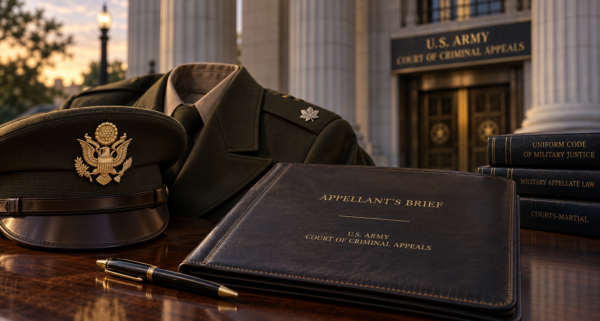
Law Offices of David P. Sheldon, PLLC asks Army Court of Criminal Appeals to review legal and factual sufficiency and whether the government disproved entrapment beyond a reasonable doubt
The Law Offices of David P. Sheldon, PLLC filed an appellate brief on September 15, 2026, on behalf of an Army officer asking the United States Army Court of Criminal Appeals to set aside a court-martial conviction and sentence arising from an undercover internet investigation.
The servicemember’s identity is being withheld from this release.
The filed brief presents two principal assignments of error: whether the evidence was legally and factually sufficient to sustain the conviction, and whether the government failed to disprove the affirmative defense of entrapment beyond a reasonable doubt. The appellant separately asks the court, pursuant to United States v. Grostefon, to consider issues involving court-martial jurisdiction and the loss of originally detailed military defense counsel.
At the center of the appeal is a basic but consequential question in criminal law: What did the accused actually know and intend when the alleged offense occurred?
An Investigation That Began With an Adult Profile
According to the appellate brief, the case began with an undercover operation on the anonymous social-media application Whisper.
Law enforcement created a fictitious profile that did not identify its user as a child. Instead, the profile represented the user as a woman older than 45. The officer later communicated with the fictitious persona through text messages and telephone conversations, all controlled by law enforcement.
The filed brief emphasizes that the initial exchanges were ordinary conversations and that law-enforcement testimony established that the appellant did not introduce sexual topics during the text-message exchanges. The brief further argues that, despite operational guidance calling for the fictitious persona’s age to be disclosed “early and often,” the persona never identified herself as 14 during the extensive written exchanges.
That sequence matters because an attempt offense requires more than conduct alone. The government must prove the specific criminal intent required by the charged offense.
The defense contends that this proof was missing.
The Age Disclosure Came After the Meeting Was Already Underway
The appellate brief says law enforcement provided the meeting location hours before the disputed age disclosure occurred.
According to the filing, the appellant was already driving toward the meeting location when an undercover officer, using her normal adult voice, participated in a telephone conversation with him. The brief states that this was the first time the appellant made sexual comments.
It also cites testimony from the undercover officer that she was unsure whether the appellant actually understood that the fictitious persona was 14 at the time those comments were made.
The brief further states that the undercover officer gave the appellant an ultimatum: make a sexual statement or the call would end. The purported disclosure that the fictitious persona was 14 came near the end of that call, after the appellant had already been traveling toward the meeting location for approximately two hours.
The defense argues that the circumstances of the call are critical. The filing describes background noise and interruptions, and the appellant testified that he did not hear the statement identifying the fictitious person as 14.
For the defense, this is not a minor factual disagreement. It goes directly to whether the government proved the required state of mind beyond a reasonable doubt.
The Military Judge’s Own Observation Raises an Important Question
The final brief adds a particularly significant point from the trial record.
After the appellant reached the location selected by law enforcement, he was immediately arrested. The appellate filing quotes the military judge as observing that the appellant was arrested and charged before he had the “best chance and opportunity to conclusively determine the identity and age of the alleged victim.”
Investigators then seized and searched three of the appellant’s phones for evidence that might demonstrate a predisposition to commit the alleged offense.
According to the filed brief, no evidence from those devices was admitted showing child sexual abuse material, child pornography, suspicious search histories, or a prior sexual interest in minors.
That evidence becomes especially important because the second principal issue on appeal is entrapment.
The Appeal Challenges Whether the Government Disproved Entrapment
Entrapment does not simply ask whether an accused ultimately engaged in certain conduct. It asks whether the criminal design originated with the government and whether the accused was already predisposed to commit the offense before government agents became involved.
The filed brief argues that law enforcement created the fictitious persona, controlled the communications, introduced the sexual subject matter, selected the meeting location, determined when the purported age would be disclosed, and directed the encounter from beginning to end.
The defense therefore argues that the government was required to establish beyond a reasonable doubt that the appellant possessed the necessary predisposition before those government actions began.
The brief contends that the government failed to do so.
It points out that searches of the appellant’s electronic media produced no evidence introduced at trial establishing that he had previously sought sexual contact with minors, communicated sexually with minors online, possessed child sexual abuse material, expressed a sexual interest in children, or engaged in similar prior misconduct.
The defense argues that conduct occurring only after repeated government interaction cannot, by itself, establish that the criminal intent existed before the government’s involvement.
The Appeal Is About More Than Whether a Meeting Occurred
The defense does not dispute that the appellant ultimately traveled to meet the person he believed he had been communicating with.
The legal question is different.
The government was required to prove that the appellant possessed the particular criminal intent alleged in the charge. The appellate brief argues that traveling to meet someone is not enough to establish that the appellant intended sexual activity with someone he believed to be 14.
The filing argues that the government’s theory required one inference to be placed on top of another: that the appellant heard the age disclosure during a noisy call while driving; that he understood it; that he immediately abandoned the understanding created by an adult profile and an adult female voice; and that his continued travel thereafter demonstrated the specific intent required for conviction.
The defense maintains that due process requires more than a chain of speculative inferences to establish guilt beyond a reasonable doubt.
The brief therefore asks the Army Court of Criminal Appeals to conduct its own review of both legal and factual sufficiency under Article 66 of the Uniform Code of Military Justice.
Why Factual Sufficiency Review Matters
Military appellate review provides protections that are especially important when a conviction turns on disputed facts and disputed inferences about intent.
The filed brief relies on Article 66, UCMJ, which permits a Court of Criminal Appeals, under the applicable statutory standard, to weigh evidence and consider controverted questions of fact after an appellant makes the required showing of a deficiency in proof.
Here, the defense asks the appellate judges to look beyond the fact that an arrest and conviction occurred and examine what the evidence actually established about the officer’s understanding and intent.
That review carries substantial consequences.
The military judge sentenced the officer to dismissal from the Army and 36 months of confinement. The officer had pleaded not guilty to the offense for which he was convicted, and the military judge separately found him not guilty of another specification alleging attempted sexual abuse of a child.
For a military officer, a dismissal can reach well beyond the courtroom. A criminal conviction and punitive separation can affect a career built over many years of service, professional standing, financial security, military benefits, family stability and reputation.
That is why meaningful appellate review matters.
Appellant Separately Preserves Jurisdiction and Counsel-of-Choice Issues
In addition to the two principal assignments of error, the appellant personally asks the Army Court of Criminal Appeals to consider two additional matters pursuant to United States v. Grostefon.
The first questions whether the military established personal jurisdiction under Article 2 of the UCMJ. The jurisdictional issue was litigated at trial, and the appellant asks the appellate court to independently review the military judge’s ruling and the requirements of Army Regulation 27-10.
The second concerns the appellant’s military defense counsel.
According to the filing, one of the appellant’s originally detailed military defense counsel was released from the case while the proceedings were underway. The appellant personally maintains that the loss of that counsel was detrimental to preparation and presentation of the defense and asks the court to determine whether the change violated his statutory or constitutional rights.
These issues are separately preserved for appellate review and are distinct from the two principal assignments of error presented in the filed brief.
The Government Still Bears the Burden
Undercover investigations are legitimate law-enforcement tools. But their use does not reduce the government’s burden of proof.
When government agents create the identity, control the conversation, determine when critical information is provided, introduce sexual content and direct the eventual meeting, careful examination of knowledge, intent and predisposition becomes particularly important.
A criminal conviction cannot rest simply on what events looked like after an arrest. The evidence must establish the required elements of the charged offense under the applicable burden of proof.
That principle is at the heart of this appeal.
The Law Offices of David P. Sheldon, PLLC asks the Army Court of Criminal Appeals to review the evidence, the conduct of the undercover investigation and the government’s proof of intent and predisposition.
The relief requested is significant. The appellant asks the court to set aside the findings of guilt, dismiss the charge with prejudice and set aside the sentence.
The filing was electronically submitted to the Army Court and Government Appellate Division on September 15, 2026.
The appeal remains pending. The arguments described in this release are positions advanced on behalf of the appellant and have not yet been resolved by the Army Court of Criminal Appeals.
About the Law Offices of David P. Sheldon, PLLC
The Law Offices of David P. Sheldon, PLLC, located in Washington, D.C., represents members of the United States Armed Forces, officers, veterans and federal employees in complex military and federal matters.
The firm’s military practice includes courts-martial, military criminal appeals, administrative separation matters, correction of military records, disability and medical proceedings, security-clearance matters, adverse personnel actions and federal litigation affecting the careers, reputations and earned benefits of those who serve.
The firm represents clients throughout the United States and worldwide in matters arising under the Uniform Code of Military Justice, military administrative law and federal law.
Law Offices of David P. Sheldon, PLLC
100 M Street SE, Suite 600
Washington, DC 20003
MilitaryDefense.com
Disclaimer
This press release is provided for informational and educational purposes only. It does not constitute legal advice and does not create an attorney-client relationship with the reader.
The factual descriptions and legal positions discussed in this release are drawn from the appellant’s filed brief and the trial record as characterized in that filing. Arguments submitted on appeal are advocacy positions presented for judicial review and should not be understood as findings by the Army Court of Criminal Appeals.
Every military justice matter depends upon its individual facts, procedural history and applicable law. Prior results do not guarantee or predict the outcome of any other matter.